
Finding Santa Maria Residents
Santa Maria resident research starts with the strongest clue available. An address or APN leads to the Santa Barbara County Assessor, the county GIS map, and then the Clerk-Recorder's official index. A full name can lead to a court party search, a professional license, an obituary, or a business filing. An old address calls for the Santa Maria Public Library's directories, newspapers, yearbooks, and census access.
Each source describes a different relationship. An assessor parcel ties a situs address to tax characteristics, not a household roster. A deed names parties to an instrument, not every person living at the property. A voter-status result belongs to the authenticated voter, not to a public street list. The Santa Maria residents directory is most useful when a result is treated as one dated clue and checked against a second custodian.
- Start with the county parcel lookup if an address is known. Enter the house number and a partial street name, omit the street suffix, and save the APN and situs address.
- Use the County GIS map to confirm the parcel polygon and jurisdiction. This helps separate a Santa Maria city parcel from a nearby county parcel that shares a postal line.
- Search the recorded-document index by the relevant grantor or grantee, then narrow by document type and recording date. Keep the instrument number with the result.
- For a person, compare a court case, license, business record, obituary, or directory entry with an address, date, relative, or occupation before treating namesakes as one person.
- When an index stops short, use a City or County Public Records Act request, a clerk terminal, a library reference request, or an archive finding aid instead of guessing.
Note: A name match becomes stronger when two independent records share an address, date range, relationship, or document number.
Santa Maria Offices Behind Resident Records
Santa Maria sits in Santa Barbara County but is not the county seat. That split matters. The County Clerk-Recorder handles deeds, recorded instruments, vital copies, marriages, fictitious business names, and other clerk filings. The Assessor handles parcel identity and assessed value. Elections administers registration and election data. The Superior Court, rather than a city municipal court, holds the trial records for Santa Maria matters.
The City adds a separate layer. The City Clerk holds council, contract, election, campaign, and administrative records. Community Development's eTRAKiT portal attaches permits and inspections to a city address or parcel. The library's second-floor Special Collections connects current questions to city directories, telephone books, yearbooks, newspaper microfilm, photographs, and genealogy works.
Santa Barbara County Clerk-Recorder
Recorded documents, vital copies, marriages, and clerk filings
Modern and historical index routes
County Clerk-Recorder services
Santa Barbara County Assessor
Parcel, situs, value, map, and transfer fields
Address or APN search, not owner-name search
Santa Barbara County Elections
Registration administration and precinct statistics
California voter status is a self-lookup
The Santa Barbara County Clerk-Recorder hub is the county-side starting point for deeds, vital copies, marriages, and other filings.
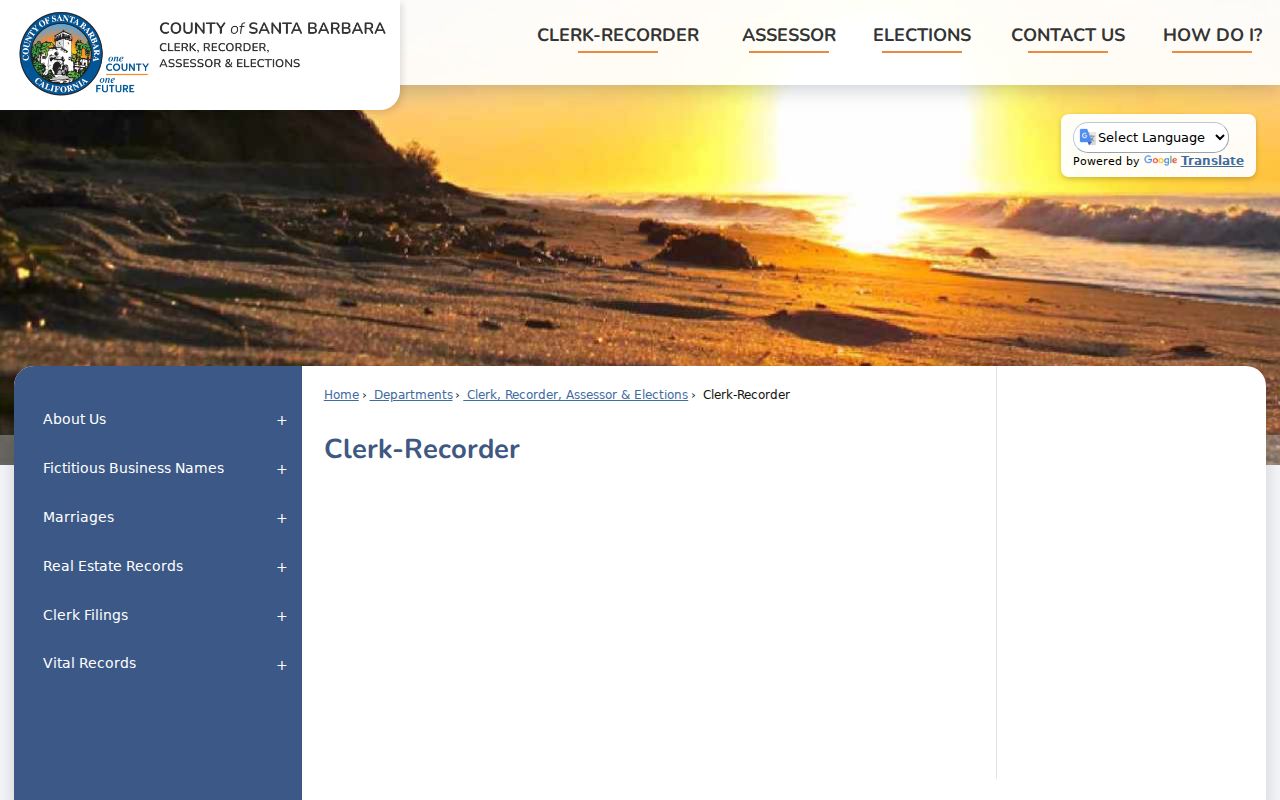
Use the office map to choose the right record family before searching. A shared department name does not make assessment, recording, elections, and vital access the same process.
The City Clerk's public-records route is separate from the county chain. Requests can seek an identifiable city record, but an agency does not have to create a new list of residents that it never maintained.
Santa Maria's Address-to-APN Starting Point
The public Assessor form is built for an address or parcel number. It does not provide an owner-name field. Enter a house number, optional unit, and street name without the suffix such as Street or Boulevard. Partial street text can help when a spelling or direction is uncertain. Sort by parcel number or street, then open the matching parcel card and retain its situs, APN, transfer, value, and map links.
That limitation is useful rather than frustrating. It keeps the parcel search from being mistaken for a resident directory. Once an APN is known, Santa Barbara County GIS can show parcel and jurisdiction layers. A map click is a spatial confirmation, not proof that a person occupies the parcel.
| Assessor field | What it does in a Santa Maria search |
|---|---|
| Parcel number | Identifies the tax parcel and provides a bridge to maps and recorded instruments. |
| House number | Starts a situs-address search; combine it with the street name. |
| Unit | Narrows a multiunit result when the public record carries a unit value. |
| Street name | Use partial text and omit the suffix when the form's search instructions call for it. |
| Sort order | Parcel number or street order helps inspect nearby results, with corner and multiunit limits. |
The inspected parcel card can show situs, transfer date, document number, use, jurisdiction, acreage, map, exemptions, and assessed values. It does not expose an owner name or mailing address in the public schema. Ownership questions move to the Recorder chain or a lawful counter or records request.
The County GIS screenshot below represents the map layer that follows the parcel lookup. Open the County GIS access page before relying on a boundary or jurisdiction label.
A GIS parcel is an assessed geography. It is not a list of household members, and it is not a legal survey.
Santa Maria's Three Recorder Time Layers
The County's recorded-document trail is layered. The official navigation identifies a Real Estate Records Index for records after 1975 and a separate Historical Index for 1931 through 1974. Older deed books and maps require the historical archives or a counter route. The portal itself has a coverage discrepancy, with current search material also describing indexed records beginning January 1, 1900. Preserve both descriptions and check the record tier rather than silently treating one cutoff as complete.
Search Party Name, Document Title or Type, Document Number, and a recording-date range. Grantor means the party conveying an interest; grantee means the party receiving it. Trust names, married or maiden names, compound surnames, parcel splits, and reconveyances can change the terms that appear in the index. An index hit identifies an instrument. An image or ordered copy supplies the legal description, signatures, vesting, and other details when available.
- Modern official index: after 1975, for recent deeds, liens, releases, and reconveyances; start with the free index search, then check image or copy access.
- Historical index: 1931-1974, for an older grantor-grantee bridge through the County historical index and counter.
- Older books and maps: use the archive inventory, historical books, and map finding aids when the exact run controls early title or parcel history.
Note: A recorder index is a finding aid, not title insurance; use the instrument or certified copy when the legal description matters.
Today's Santa Maria Resident Sources
There is no single current Santa Maria residents directory. The practical sources divide by purpose and by what the custodian is allowed to disclose. Property records show parcel relationships. City permits show dated project activity. Court indexes show public case relationships. Library and state searches add community or historical context. None should be expanded into a claim about every person at an address.
| Record source | Signal it provides | Keeper | Access boundary |
|---|---|---|---|
| Assessor parcel card | Situs, APN, transfer, use, value, and map data | County Assessor | Free address/APN lookup; no public owner-name query |
| Recorded-document index | Parties, instrument type, date, and number | County Clerk-Recorder | Index free; image or copy availability varies |
| eTRAKiT | Permit, inspection, applicant, contractor, and address context | City Community Development | Public search; accounts for application work |
| Court Smart Search | Case number, parties, category, events, and status where public | Santa Barbara Superior Court | Restricted matters and some documents are excluded |
| Library collections | Subscribers, students, obituaries, photographs, and chronology | Santa Maria Public Library | Special Collections, microfilm, digital items, and reference help |
Official records have a custodian and a correction route. Commercial people-finding products merge public and private feeds, may be stale, and can join two namesakes. They can be described as leads, but a Santa Maria resident lookup should return to the County, City, Court, State, or Library source that created the underlying record.
| Comparison point | Official record route | Commercial people-finding category |
|---|---|---|
| Source | A named County, City, Court, State, or Library custodian with a defined record series. | Mixed public and private feeds assembled by an outside provider. |
| Best use | Verify a dated parcel, case, permit, directory, or vital-record clue. | Generate a lead that must be checked against the source office. |
| Correction path | Return to the custodian with the APN, case number, instrument, or record reference. | Provider-specific process, unclear provenance, and no substitute for the originating record. |
Keep the purpose lawful. Public availability does not permit stalking, harassment, intimidation, impersonation, or an attempt to defeat a protected address. Use a source for personal research, family history, civic records, or another lawful purpose.
Santa Maria eTRAKiT Knows the Address
Santa Maria's eTRAKiT portal is the city-facing address index. The official guide describes property and permit searches, applications, inspections, payments, and permit-number views. A public search can establish that a permit exists and can reveal dated applicant, contractor, owner-context, or inspection information. It does not turn a permit party into a confirmed resident. The owner value can prepopulate from the County Assessor and may lag a recent transfer.
Use Address or Parcel in the location control. Santa Maria address matching expects a valid city record and recommends single-letter directionals such as W rather than West. Permit type depends on the workflow. Applications can ask for contact information, uploads, a disclaimer agreement, and a final submit or view-permit action. Full plan sets may require a CPRA request and authorization because plan materials can carry access and copyright limits.
The Santa Maria eTRAKiT search screenshot below shows the public property and permit route. The official eTRAKiT guide supplies the city's own field and workflow instructions.
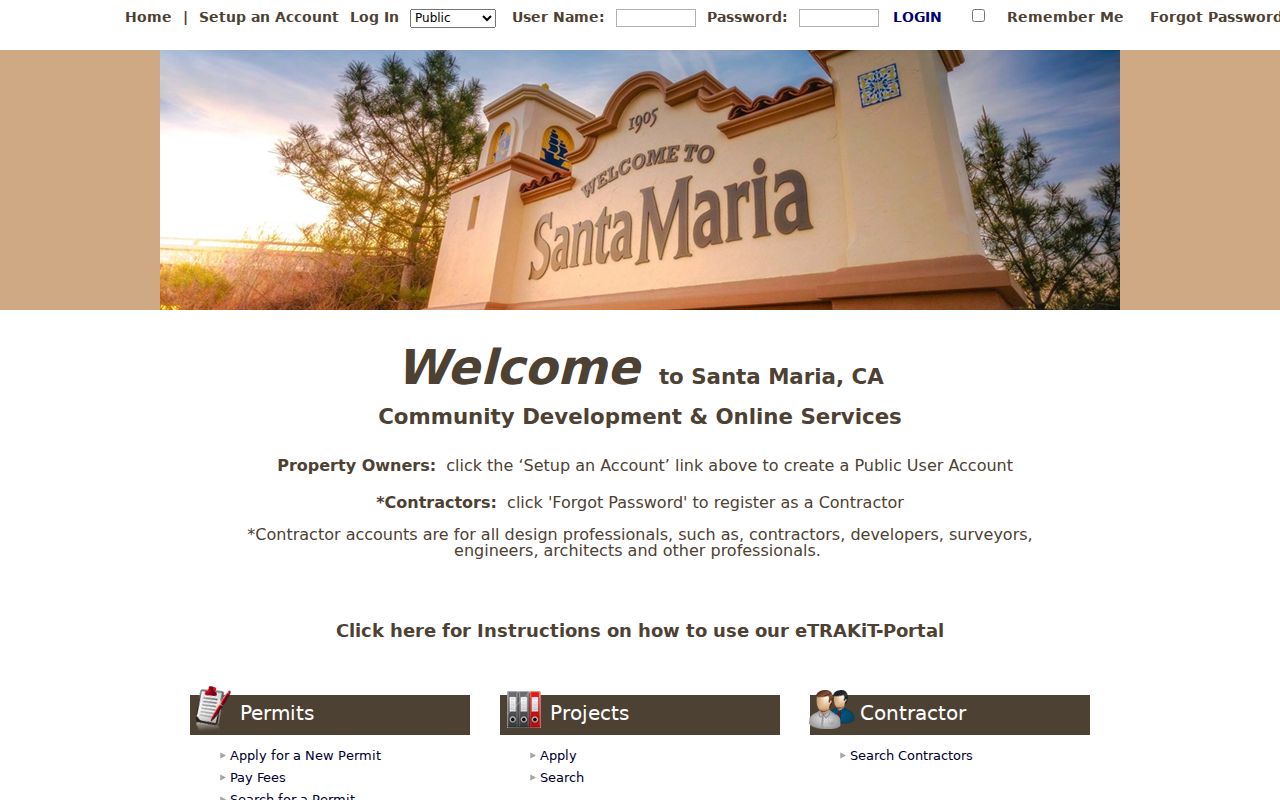
Inspection status is updated daily by 8 a.m., according to the guide. Record the permit number and date, then use the City Clerk or Community Development records route when the public result is not enough.
California Voter Status for Santa Maria
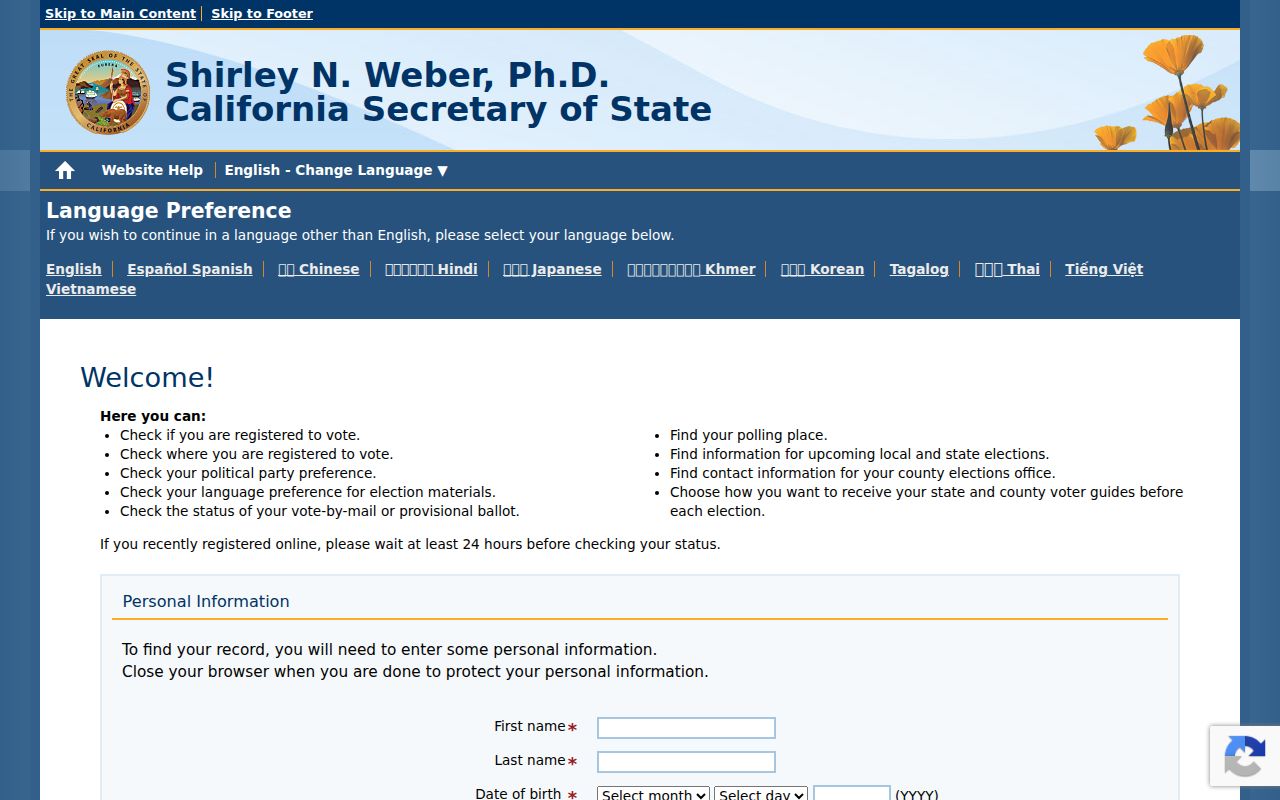
California's voter-status tool is often mistaken for a public Santa Maria resident lookup. It is not. The form authenticates the requester with first name, last name, date of birth, and a driver license or state ID number or the last four digits of a Social Security number. It returns the matching voter's status, party preference, voting location or district, and vote-by-mail or provisional information where applicable. A no-match is not proof that a person does not live in Santa Maria.
Election Code sections 2180 through 2194 restrict voter-registration information. Driver-license and Social Security values, unique identifiers, and signatures are withheld. A full-file request is limited to permitted requesters and purposes, requires a declaration, and uses the state's application and fee schedule. That regime is different from an open web directory keyed by street. Safe at Home participants and other protected people can also have addresses shielded.
- First and last name: matches the registered form of the voter's name.
- Date of birth: provides an identity check rather than a public name filter.
- California ID or SSN4: one protected identifier is required as presented, with an “I do not have” option.
- Submit result: returns the authenticated voter's own status and election details.
The California voter-status lookup capture below illustrates that authenticated design. It should verify the requester's own registration, not be repurposed as a street-by-street list.
Note: Election results can show precinct or district totals, but they do not reveal how an individual cast a ballot.
Santa Maria Court Names and Dockets
Santa Maria cases belong to the Superior Court of California, County of Santa Barbara. Start with Smart Search when a case number, party name, or business name may exist. A public result can show a case number, caption, category, filing date, status, party roles, hearings, register-of-actions entries, and a disposition or judgment when entered. A party match remains a lead until case number, role, date, and geography align.
The court's remote access has practical limits. Case-number information is free. Party or business-name searches require a login and search credits. Remotely available civil filing images cost $0.50 per page. Family, juvenile, adoption, sealed, confidential, mental-health, and restricted criminal material does not appear like an ordinary public civil docket. A Santa Maria clerk or public terminal can provide a better route, followed by a copy request for ordinary, certified, or exemplified material.
The Santa Barbara Superior Court information hub explains locations, forms, records, and divisions. The court-portal capture below shows the first step before a clerk-file request.
Probate is especially useful for an heir trail because petitions, notices, fiduciaries, and heirs may appear in a public file, while sensitive inventories or addresses may be restricted. Court records establish a dated case relationship, not a current household.
Santa Maria CPRA Requests When Portals End
The California Public Records Act, now Government Code sections 7920.000 and following, reaches identifiable nonexempt state and local records. Santa Maria's City Clerk page explains inspection, direct reproduction costs, and a determination generally due within ten calendar days under Government Code section 7922.535, with a written unusual-circumstances extension of no more than fourteen days. A determination is not a promise that every responsive record will be delivered by day ten.
Use the Santa Maria public-records request portal for non-police city records, or begin with the City Clerk's CPRA instructions. A useful request names the record series, a reasonable date range, an address or APN, a permit or instrument number, and the preferred inspection or electronic-copy method. Agencies must help identify records but do not have to create a resident list that never existed.
- Describe the existing record, such as permit history, council filing, contract, or nonexempt administrative record.
- Name Santa Maria, the department, the address or APN, and the time window that narrows the search.
- Ask for electronic inspection first and request an exemption or redaction explanation for withheld material.
- Track the request number and compare the response with the City's published fee and access terms.
The City request portal image below is a reminder that the records channel is a request for an existing city record, not a shortcut around a confidential series.
Note: Police, juvenile, medical, investigative, and personal identifying material can carry separate confidentiality rules even after a CPRA request.
Santa Maria's ZIP and Orcutt Postal Trap
Santa Maria's postal geography can send a search down the wrong government path. ZIP 93455 can say Santa Maria in the mailing line while the parcel sits in unincorporated Orcutt. Some 93454, 93456, and 93458 addresses align with Santa Maria planning geography, while 93457 carries a separate south-area routing history. The ZIP code routes mail; it does not establish city limits, a tax parcel, or occupancy.
For a mixed result, verify the postal line with the USPS ZIP lookup, the parcel and boundary with County GIS, and the permit custodian with the jurisdiction. An eTRAKiT no-result can mean county regulation rather than a false address. The 2017 USPS routing bulletin records the 93456 move from Guadalupe 93434 to Santa Maria 93454, but individual addresses still need current verification.
Santa Maria Vital Record Access
Birth, death, and public-marriage records sit with the County Clerk-Recorder for county events and with California Department of Public Health Vital Records for statewide copies. Divorce decrees come from Superior Court, not the recorder. California separates an authorized certified copy from an informational certified copy under Health and Safety Code sections 103525 and 103526. Confidential marriage copies are restricted to the parties or a court order.
The statewide system begins in July 1905 for births. The research record gives 2026 CDPH fees of $31 for birth, $26 for death, $19 for marriage, $18 for a dissolution certificate, $23 for fetal death, and $28 for stillbirth, with a no-record search retaining its fee. Verify the current record-specific form and fee before mailing. Historical indexes are not the same as eligibility for a modern certificate.
- Birth, death, or public marriage: use the County Recorder or CDPH route and distinguish a county event from the record type and copy category.
- Confidential marriage: use the County Recorder route and confirm party access or court-order authority.
- Divorce decree: use Santa Barbara Superior Court and distinguish the court judgment from a state statistical certificate.
The California Vital Records page has record-specific applications and ordering routes. A vital index can suggest a relationship or date; the custodian decides whether a certified copy can issue.
Santa Maria's Historical Directory Shelf
Santa Maria Public Library Special Collections is the local starting point for the historical Santa Maria residents directory. The second-floor Information Desk controls city directories, telephone books, high-school yearbooks, government documents, historic photographs, more than 800 genealogy titles, and regional newspaper microfilm beginning in 1882. The online materials do not publish a complete publisher-by-year run, so the exact issue list must be confirmed with reference staff rather than filled with an assumed Polk span.
Older city directories can show a listed adult, spouse notation, occupation, business affiliation, street address, residence marker, telephone clue, or owner/occupancy symbol. A reverse or criss-cross section changes the order to street and house number. It can help connect an old address to a name, but it still describes the person listed or subscribed, not every member of a household. The historical shelf and reading method receive fuller treatment on the Santa Maria city directory collections page.
Santa Maria's 1882 Newspaper Bridge
Regional newspaper microfilm beginning in 1882 predates Santa Maria's 1905 incorporation. That makes the library's newspaper shelf a bridge between county-era records and the later city record system. Sales notices, street changes, social announcements, business names, school events, and obituaries can explain why a directory entry disappears or why a deed party changes names.
Library reference staff retrieve up to three Santa Maria Times obituaries at no fee when given a deceased person's name and death date, with a two-week range accepted. Supply a return email or address. An obituary can connect relatives and chronology, but it is secondary evidence and should be paired with a directory, deed, court, or vital record.
Santa Maria Matches Need Context
Four location systems can describe the same place differently: a ZIP code routes mail, a situs identifies the assessed location, a mailing address receives correspondence, and a legal description identifies land through a lot, block, subdivision, or metes-and-bounds description. A parcel can cross a historic annexation, a road can change name or number, and a directory can use an older rural route. Retain the source date and the exact spelling at every step.
- Roll
- A recurring list kept for a defined administrative purpose, such as assessment or election administration.
- Index
- A finding aid that points to a record; it is not always the image or certified copy.
- Parcel
- A mapped tax unit identified by an APN, which can change after splits or boundary work.
- Criss-cross directory
- A reverse directory arranged by street and number rather than only by surname.
California's Safe at Home program can replace a qualifying participant's public address with a substitute mailing address. DMV personal information is also protected under the federal Driver's Privacy Protection Act. A careful Santa Maria residents directory workflow accepts a negative result, records its reason, and returns to the official custodian instead of trying to defeat those protections.