
What a Santa Maria Lookup Confirms
A Santa Maria resident lookup should begin with the record that matches the question. An address points to the Assessor and GIS. A name and possible case relationship point to Superior Court. A professional identity points to the California license search. Family history may call for a directory, obituary, yearbook, probate file, or vital-record application. Each record has a custodian, a date, and an access rule.
| Record route | What it confirms | Where it lives | Access boundary |
|---|---|---|---|
| Parcel and deed records | Address/APN link, situs, named instrument parties, and transfer context | County Assessor and Clerk-Recorder | Address/APN search; images and ownership details vary |
| Voter status | The authenticated voter's registration status and election details | California SOS and County Elections | Self-lookup, not an open name or street directory |
| Superior Court index | Case number, party role, category, dates, events, and disposition where public | Santa Barbara Superior Court | Restricted cases excluded; name searches may require credits |
| Vital-record route | Birth, death, marriage, or dissolution event and relationship evidence | County Clerk-Recorder or CDPH | Copy type and eligible relationship control access |
| License, business, or FBN file | Professional status, entity affiliation, agent, or assumed-name context | California DCA, SOS, County, or City | Business address is not proof of residence |
| Library and newspaper sources | Chronology, school or club connection, kinship, and past listed address | Santa Maria Public Library | Special Collections, microfilm, digital items, or reference request |
Start with the least ambiguous clue. An instrument number or case number is better than a common surname. A known address is better than a postal city. A relative, age range, or organization can separate namesakes. The result belongs in a dated research note with the source and search method.
Separating Santa Maria Namesakes
The same-name trap is especially serious in a county record chain. Santa Maria names can appear with a missing middle initial, a compound surname, an accent removed, a marriage name, a maiden name, or either order of Spanish surnames. Treat surname and city as a starting point only. Match at least two independent dimensions before combining records.
Useful dimensions include an address or APN, a case number, a filing date, a spouse or relative, an age range, a license number, an entity role, an occupation, or a consistent chronology. Search joined and separated forms, omit accents when a portal normalizes them, and preserve the exact form printed in the result. A mismatch is a reason to split the research trail, not to force a match.
The safest result says “possible match” until a second custodian supports it. The County Recorder index can supply a dated instrument role, while the Assessor can verify a known address or APN. Neither one alone confirms present residence.
Santa Maria Court Names and Dockets
Santa Maria uses the Superior Court of California, County of Santa Barbara. Its Smart Search supports case or party and business-name modes, with case category, location, and date controls where displayed. Use a name result to capture the case number, caption, category, filing date, party role, status, hearings, register-of-actions entries, disposition, and document indicator.
Remote access has a cost and login distinction. Case-number information is free, while party or business-name searches require a login and search credits. Remotely available civil filing images cost $0.50 per page. A clerk or public terminal may expose docket material that is not visible remotely. Family, juvenile, adoption, sealed, confidential, and certain criminal matters are limited.
| Portal field | How it helps a Santa Maria resident lookup |
|---|---|
| Search type | Switches between party or business name and case number. |
| Search criteria | Accepts a name or exact case number, subject to the portal's live rules. |
| Category, location, dates | Narrows a common name by court division, case type, or filing period. |
| Result record | Provides case number, role, events, status, and public disposition indicators. |
The Santa Barbara Superior Court Smart Search portal is the online first step. The court access instructions explain the portal and copy routes. The Superior Court information hub lists locations, divisions, and records contacts. A federal case belongs in the PACER case locator, not the Santa Barbara County index.
Verifying a Santa Maria Resident Record
A useful resident lookup makes the name earn its place. Start with a known fact, add a second independent source, and stop when the evidence answers the question. The workflow below is designed for a family, civic, or personal-record question, not for treating a search result as a complete portrait of a person.
- Anchor the name to a known address, APN, date, relative, organization, or license number. The public Assessor search is address/APN based, so it cannot start with an owner name.
- Run Superior Court Smart Search with the exact name and defensible variants. Record the case number, party role, category, filing date, and status instead of copying only the name.
- Check a second record route, such as a deed instrument, license number, business filing, obituary, yearbook, or directory entry. Look for a matching address, date, or relationship.
- Order a certified or informational copy only from the custodian when the event or legal record matters. A search hit is not the same as a certified document.
- Docket
- The court's running record of a case's filings, events, hearings, and status.
- Index versus image
- An index summarizes or points to a record; an image is the filed instrument or page, which may require a fee or clerk access.
- Certified copy
- A copy issued and authenticated by the custodian for an authorized purpose; eligibility varies by record.
A correction belongs with the source office. The Assessor handles parcel data, the Recorder handles indexing or redaction questions, the Court handles docket and file concerns, Elections handles registration, and a licensing board handles license status.
Santa Maria Property Is Not Residence
The County Assessor parcel card can connect a known street address to an APN, situs, transfer date, document number, jurisdiction, land use, acreage, map, exemptions, and assessed value. Its public form does not expose an owner-name field, and the inspected result did not show an owner mailing address. A parcel clue is therefore a way to test a known address, not a public occupant list.
Recorded documents add named parties to deeds, liens, releases, and reconveyances. Those parties may be owners, trustees, beneficiaries, lenders, or other instrument participants. A deed chain can establish title history, but title is not occupancy. If the lookup question shifts from one person to everyone on a street, the Santa Maria street directory address workflow is the better angle.
Santa Maria License and Business Clues
State and local business records can separate namesakes without pretending that a business address is a home address. The California Department of Consumer Affairs search accepts a name, license number, board, city, or county and can return license type, status, issue or expiration information, and discipline links where public. The Secretary of State's bizfile search adds entity name or number, status, agent, principal address, and filing context. County fictitious business names fill a different local role.
The California license search capture below shows the official professional-record route. Save the license number and board before comparing a result with a Santa Maria court, deed, or library record.
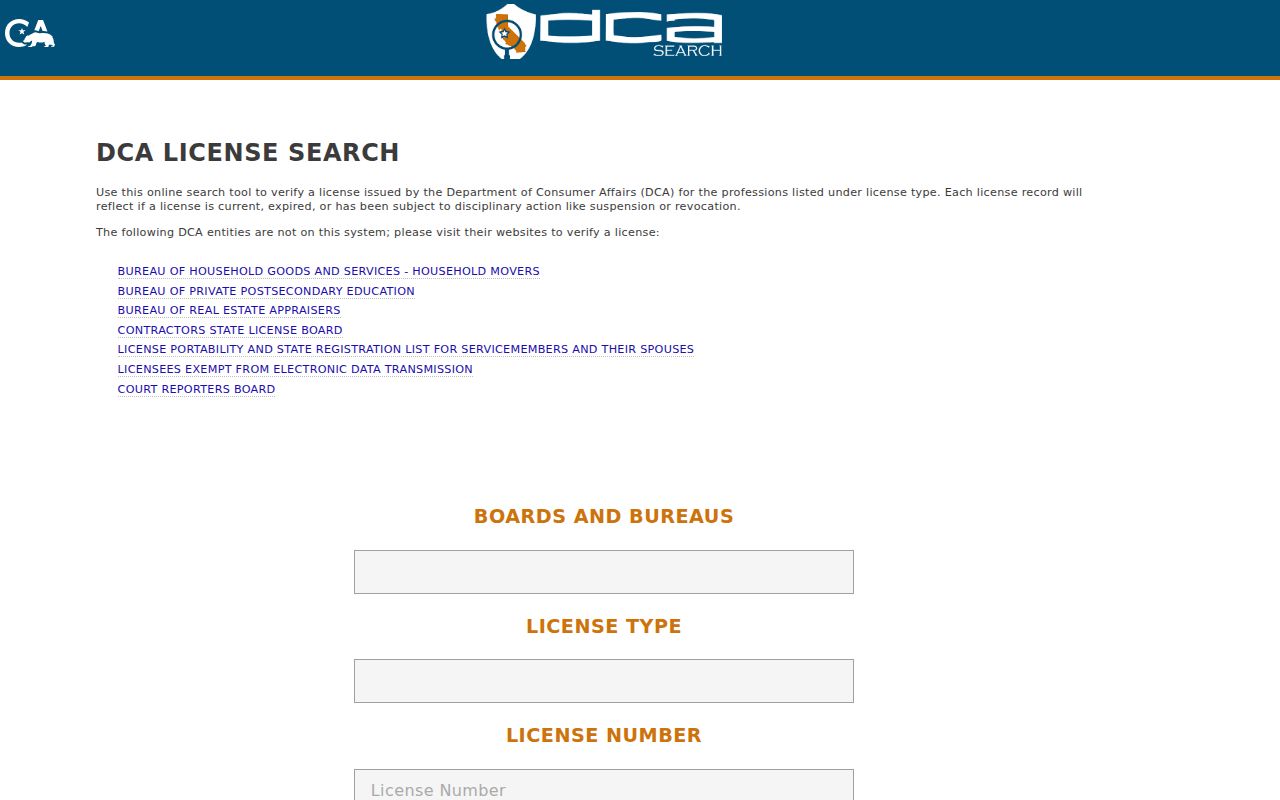
Licensing details establish professional status or an affiliation at a point in time. They do not establish present residence, and an entity agent address may be outside Santa Maria.
The California bizfile business search can be paired with a County fictitious business-name filing. A sole proprietor may have an assumed-name filing without a corporation, while a corporation may use an agent address outside the city.
Unclaimed Property as a Santa Maria Clue
The California State Controller's unclaimed-property search accepts surname, given name, city, or ZIP. A hit can preserve an older reported address or business relationship, but it should never be treated as a current location. Claim details and identity checks belong to the Controller, not a directory search.
The State Controller unclaimed-property search is free, and the owner can claim directly. The capture below shows the name and location clue without turning an old report into a present-resident claim.
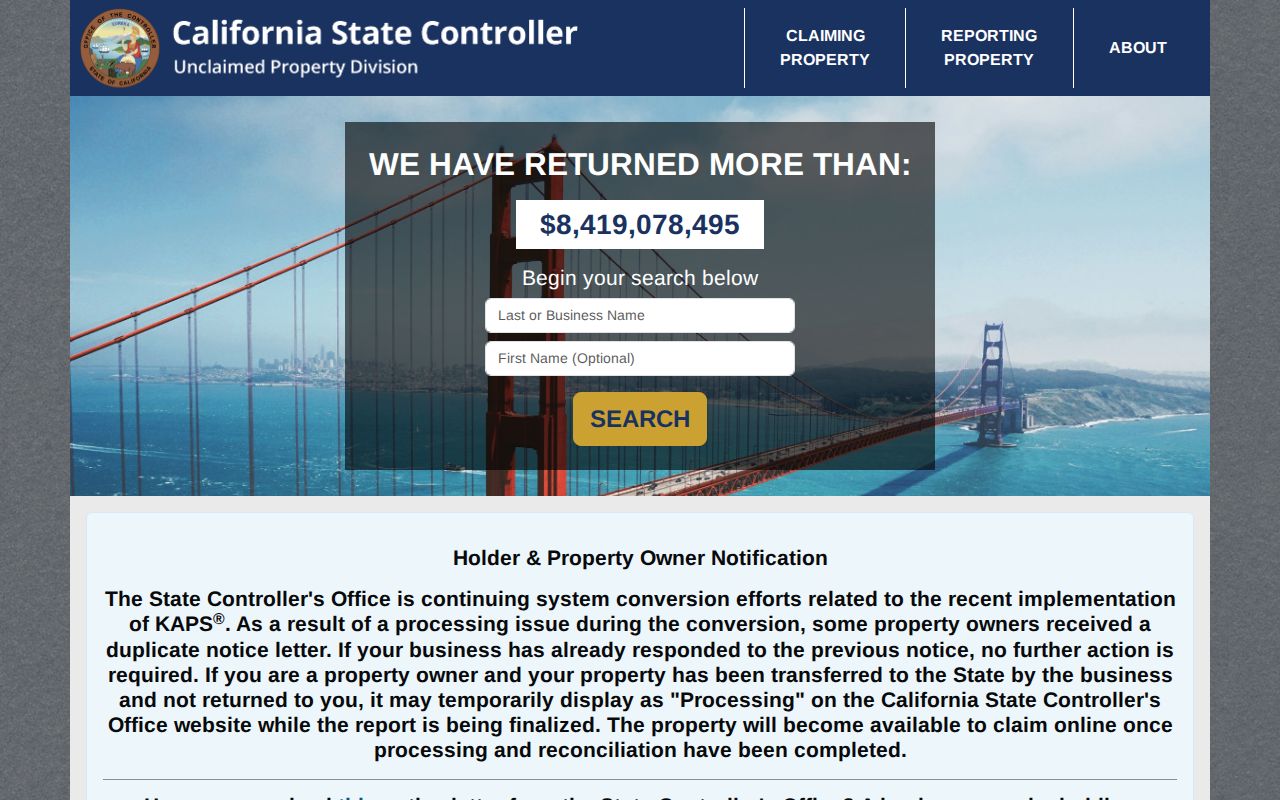
Compare a hit with a dated directory, newspaper, court, or recorder result. The useful signal is the relationship and date, not an assumption that the same person still receives mail at the reported location.
Heirs, Classmates, and Santa Maria Chronology
Specific personal questions have their own local paths. Probate petitions, notices, and orders may identify a decedent, fiduciary, or heir. The library's city directories, Minerva Club yearbooks, Luna photographs, and newspaper microfilm can identify a former classmate, organization, or family connection. The library can retrieve up to three Santa Maria Times obituaries at no fee when given a name and a death date with a two-week range.
For an heir trail, search the public probate index, capture the case number and roles, then ask the clerk for the ordinary or certified material allowed in the file. For a classmate, pair a yearbook name with a directory, obituary, or census age range. For a birth-parent question, use California's official adoption-information procedures because sealed adoption records are not bypassed through a resident lookup.
Each trail benefits from the same rule: record what the source actually says. A photograph can place a person in a club or event. An obituary can connect relatives. A probate file can identify a legal role. None should be expanded beyond its date and scope.
California Vital Copies for Santa Maria Research
Santa Barbara County Clerk-Recorder issues county birth, death, and public-marriage copies, while California Department of Public Health provides statewide record-specific applications. California separates authorized certified copies from informational certified copies under Health and Safety Code sections 103525 and 103526. An authorized copy requires an eligible relationship and sworn statement. An informational copy is marked as not valid to establish identity.
Confidential marriage copies are restricted to the parties or a court order. Divorce decrees come from Superior Court, not the Recorder, while CDPH's dissolution certificate is a statistical record. There is no simple modern “open after N years” rule that replaces copy eligibility. Historical indexes and genealogy databases expose different, limited facts.
The California Vital Records applications page and the County Recorder's record-copy route identify the custodian. Common form fields include registrant or decedent, event date and city, parents' names, relationship, purpose, signature, sworn statement, payment, and return address. Verify current fees on the record-specific form.
Santa Maria Voter Status Limits
The California Secretary of State voter-status tool requires the matching voter's identifying information and returns that voter's own status. It is not a public Santa Maria name directory. A match can show registration status, party or language preference, voting location or district, vote-by-mail or provisional information, and a county contact. A no-match can result from a name, birth-date, ID, address, or list-maintenance mismatch.
Elections Code sections 2180 through 2194 restrict access to voter data. The Santa Barbara County Elections office is the local contact for permitted voter-file routes. A permitted full-file request requires the official application, requester and organization information, purpose declaration, and any current fee or format requirements. Protected identifiers and signatures remain confidential. Safe at Home participants can have addresses shielded through the California address-confidentiality program.
The California voter-status lookup is best used by the voter who needs to check registration. It should not be used to assemble a block roster or to infer that a person is absent from Santa Maria.
Official Safety Lookups Stay Narrow
Some official searches exist for a defined public-safety or custody purpose. The California Megan's Law site may display registry information and a map or name search subject to statutory warnings. The County Sheriff custody lookup and the California Department of Corrections and Rehabilitation locator are current or status-specific tools. A booking, charge, custody entry, or registry display does not equal a conviction or establish a present home.
The California Megan's Law search capture below demonstrates the narrow official interface. Record the as-of date and verify the underlying agency or court when the detail matters.
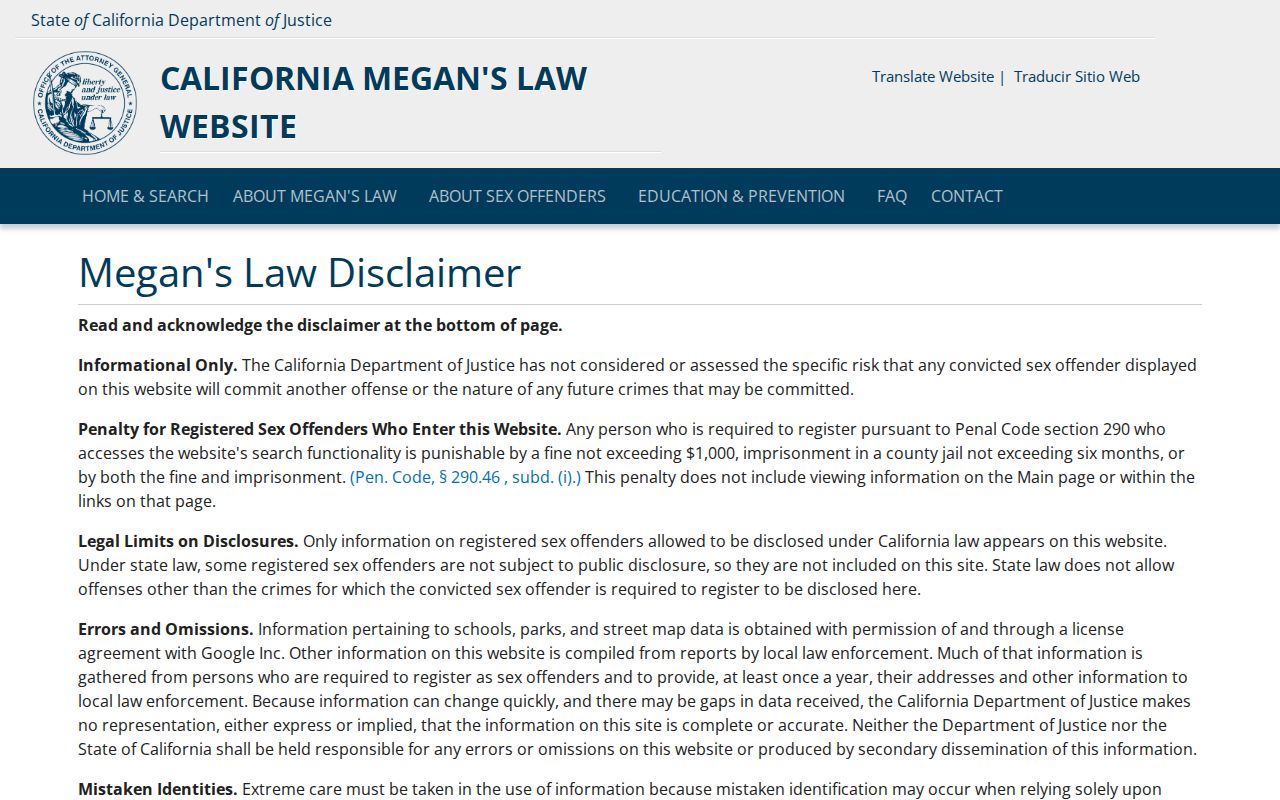
Use the County Sheriff or CDCR source for custody questions and the Superior Court for case disposition. Do not treat a public display as permission to contact, follow, threaten, or harass a person.
Legal Limits on a Santa Maria Lookup
California public records are not permission to weaponize personal information. Stalking, criminal threats, harassment, identity theft, voter-file misuse, and attempts to defeat a protected address can trigger separate state or federal rules. The Safe at Home program supplies a substitute mailing address for qualifying victims and reproductive-health participants. The federal Driver's Privacy Protection Act restricts DMV personal information.
California's consumer-privacy and data-broker rules provide deletion and opt-out routes for covered commercial data. Use an official California privacy process rather than sending identity documents to an unverified search provider. If a County, City, Court, Elections, or licensing record is wrong, preserve the instrument, case, license, or request number and ask the source custodian for its correction route.
Lawful use. Use a Santa Maria resident lookup for personal, lawful research, family history, reconnecting, or civic records. Do not use a result to stalk, harass, intimidate, threaten, impersonate, or harm anyone.