
Finding Santa Maria Residents
Start any Santa Maria resident search with the strongest clue in hand. An address or APN opens many doors. It leads to the Santa Barbara County Assessor, the county GIS map, and the Clerk-Recorder's official index. A full name points toward a court party search. It may also fit a professional license, an obituary, or a business filing. An old address leads somewhere else. It sends you to the Santa Maria Public Library, where directories, newspapers, yearbooks, and census access await.
Each source describes a different relationship. An assessor parcel ties a situs address to tax characteristics, not a household roster. A deed names the parties to an instrument, not every person living there. A voter-status result belongs to the authenticated voter, not to a public street list. Treat the Santa Maria residents directory as a set of dated clues. One result earns trust only after a second custodian confirms it.
- Start with the county parcel lookup if an address is known. Enter the house number and a partial street name, omit the street suffix, and save the APN and situs address.
- Use the County GIS map to confirm the parcel polygon and jurisdiction. This helps separate a Santa Maria city parcel from a nearby county parcel that shares a postal line.
- Search the recorded-document index by the relevant grantor or grantee, then narrow by document type and recording date. Keep the instrument number with the result.
- For a person, compare a court case, license, business record, obituary, or directory entry with an address, date, relative, or occupation before treating namesakes as one person.
- When an index stops short, use a City or County Public Records Act request, a clerk terminal, a library reference request, or an archive finding aid instead of guessing.
Note: A name match becomes stronger when two independent records share an address, date range, relationship, or document number.
Santa Maria Offices Behind Resident Records
Santa Maria sits in Santa Barbara County but is not the county seat. That split shapes everything. The County Clerk-Recorder holds deeds, recorded instruments, vital copies, marriages, fictitious business names, and other clerk filings. The Assessor keeps parcel identity and assessed value. Elections administers registration and election data. Trial records for Santa Maria matters live with the Superior Court, not a city municipal court.
The City adds its own layer. The City Clerk holds council, contract, election, campaign, and administrative records. Community Development's eTRAKiT portal attaches permits and inspections to a city address or parcel. The library's second-floor Special Collections links current questions to city directories, telephone books, yearbooks, newspaper microfilm, photographs, and genealogy works.
Santa Barbara County Clerk-Recorder
Recorded documents, vital copies, marriages, and clerk filings
Modern and historical index routes
County Clerk-Recorder services
Santa Barbara County Assessor
Parcel, situs, value, map, and transfer fields
Address or APN search, not owner-name search
Santa Barbara County Elections
Registration administration and precinct statistics
California voter status is a self-lookup
The Santa Barbara County Clerk-Recorder hub anchors the county side of any records chase. Deeds, vital copies, marriages, and other filings all begin there.
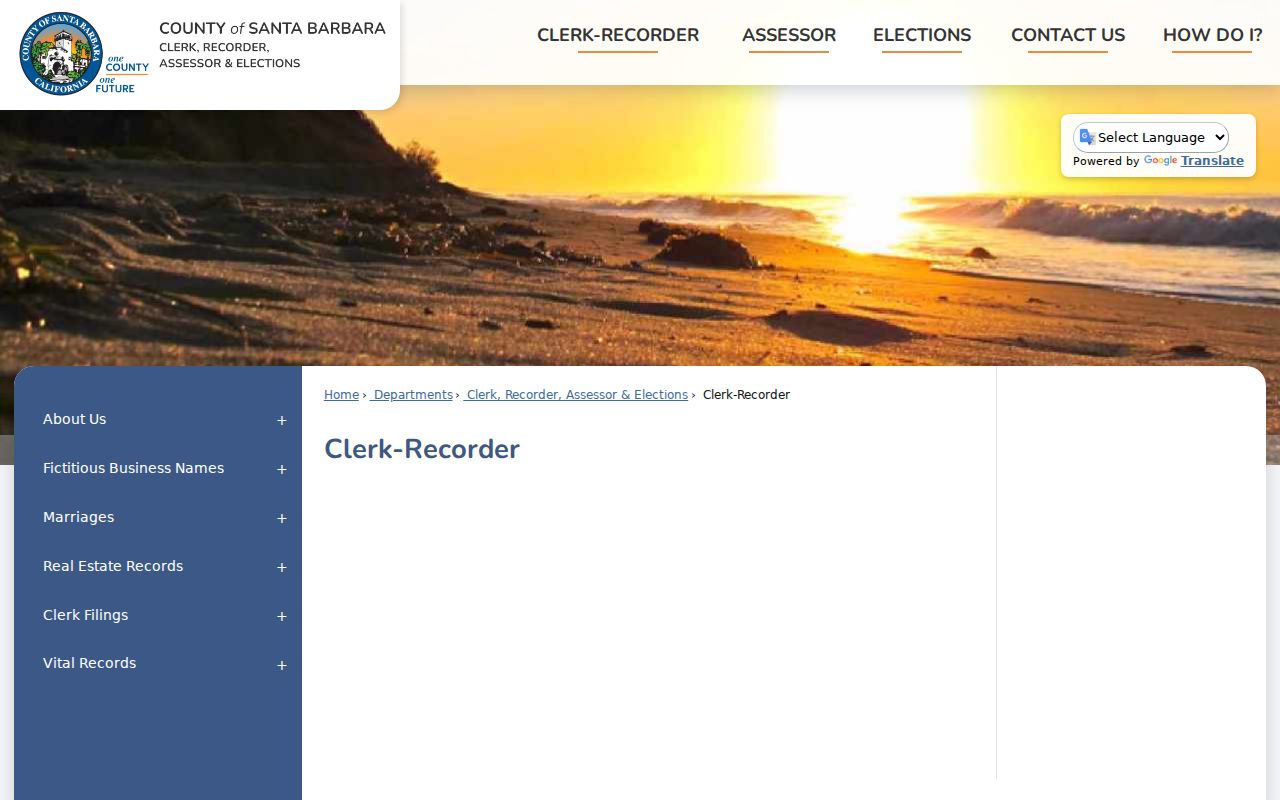
Let the office map guide you to the right record family first. Assessment, recording, elections, and vital access may share a department name. They are not the same process.
The City Clerk's public-records route stands apart from the county chain. A request can seek an identifiable city record. No agency has to build a new list of residents it never kept.
Santa Maria's Address-to-APN Starting Point
The public Assessor form wants an address or parcel number. There is no owner-name field. Type a house number, an optional unit, and a street name without the suffix such as Street or Boulevard. Partial street text helps when spelling or direction is uncertain. Sort by parcel number or street. Open the matching parcel card. Keep its situs, APN, transfer, value, and map links.
That limit is a feature. It keeps the parcel search from being mistaken for a resident directory. Once an APN is known, Santa Barbara County GIS can display parcel and jurisdiction layers. A map click confirms space, not occupancy.
| Assessor field | What it does in a Santa Maria search |
|---|---|
| Parcel number | Identifies the tax parcel and provides a bridge to maps and recorded instruments. |
| House number | Starts a situs-address search; combine it with the street name. |
| Unit | Narrows a multiunit result when the public record carries a unit value. |
| Street name | Use partial text and omit the suffix when the form's search instructions call for it. |
| Sort order | Parcel number or street order helps inspect nearby results, with corner and multiunit limits. |
A parcel card can show situs, transfer date, document number, use, jurisdiction, acreage, map references, exemptions, and assessed values. The public schema holds no owner name or mailing address. Ownership questions move on to the Recorder chain or a lawful counter or records request.
The County GIS page displays the map layer that follows the parcel lookup. Open the County GIS access page before relying on any boundary or jurisdiction label.
A GIS parcel is assessed geography. It is not a household roster, and it is not a legal survey.
Santa Maria's Three Recorder Time Layers
The County's recorded-document trail runs in layers. The official navigation points to a Real Estate Records Index for records after 1975. A separate Historical Index covers 1931 through 1974. Older deed books and maps require the historical archives or a counter visit. The portal's own coverage descriptions differ. Current search material cites indexed records beginning January 1, 1900. Keep both descriptions in mind. Check the record tier rather than treating one cutoff as complete.
Search by Party Name, Document Title or Type, Document Number, or a recording-date range. A grantor conveys an interest; a grantee receives it. Trust names, married or maiden names, compound surnames, parcel splits, and reconveyances can all shift the terms in the index. An index hit identifies an instrument. An image or ordered copy supplies the legal description, signatures, vesting, and other details when available.
- Modern official index: after 1975, for recent deeds, liens, releases, and reconveyances; start with the free index search, then check image or copy access.
- Historical index: 1931-1974, for an older grantor-grantee bridge through the County historical index and counter.
- Older books and maps: use the archive inventory, historical books, and map finding aids when the exact run controls early title or parcel history.
Note: A recorder index is a finding aid, not title insurance; use the instrument or certified copy when the legal description matters.
Today's Santa Maria Resident Sources
No single current Santa Maria residents directory exists. What you get instead are separate record systems, each kept for its own reason. Each is limited by what its custodian may disclose. Property rolls from the Assessor tie names to parcels. City permits log dated project activity at an address, while court indexes surface public case relationships. Library and state searches round things out with community or historical context. Treat each source as one slice of the picture. Never treat it as proof of every person at an address.
| Record source | Signal it provides | Keeper | Access boundary |
|---|---|---|---|
| Assessor parcel card | Situs, APN, transfer, use, value, and map data | County Assessor | Free address/APN lookup; no public owner-name query |
| Recorded-document index | Parties, instrument type, date, and number | County Clerk-Recorder | Index free; image or copy availability varies |
| eTRAKiT | Permit, inspection, applicant, contractor, and address context | City Community Development | Public search; accounts for application work |
| Court Smart Search | Case number, parties, category, events, and status where public | Santa Barbara Superior Court | Restricted matters and some documents are excluded |
| Library collections | Subscribers, students, obituaries, photographs, and chronology | Santa Maria Public Library | Special Collections, microfilm, digital items, and reference help |
Official records have a custodian and a correction route. Commercial people-finding products lack that discipline. They merge public and private feeds, go stale, and sometimes fuse two namesakes into one phantom entry. Treat those results as leads only. A serious Santa Maria resident lookup should always return to the County, City, Court, State, or Library source that created the underlying record in the first place.
| Comparison point | Official record route | Commercial people-finding category |
|---|---|---|
| Source | A named County, City, Court, State, or Library custodian with a defined record series. | Mixed public and private feeds assembled by an outside provider. |
| Best use | Verify a dated parcel, case, permit, directory, or vital-record clue. | Generate a lead that must be checked against the source office. |
| Correction path | Return to the custodian with the APN, case number, instrument, or record reference. | Provider-specific process, unclear provenance, and no substitute for the originating record. |
Keep the purpose lawful. Public availability does not permit stalking, harassment, intimidation, impersonation, or an attempt to defeat a protected address. Use a source for personal research, family history, civic records, or another lawful purpose.
Santa Maria eTRAKiT Knows the Address
Santa Maria's eTRAKiT portal works as the city-facing address index for permits. The official guide walks through property and permit searches, applications, inspections, payments, and permit-number views. A public search can establish that a permit exists. It can also reveal dated applicant, contractor, owner-context, or inspection details. That does not make a permit party a confirmed resident. The owner value can prepopulate from the County Assessor, so it may lag a recent transfer.
Use Address or Parcel in the location control. Santa Maria address matching wants a valid city record. It prefers single-letter directionals, W rather than West. Permit type depends on the workflow. Applications may ask for contact information, uploads, a disclaimer agreement, and a final submit or view-permit action. Full plan sets can require a CPRA request plus authorization. Plan materials carry access and copyright limits.
The Santa Maria eTRAKiT search page displays the public property and permit route. The official eTRAKiT guide supplies the city's own field and workflow instructions.
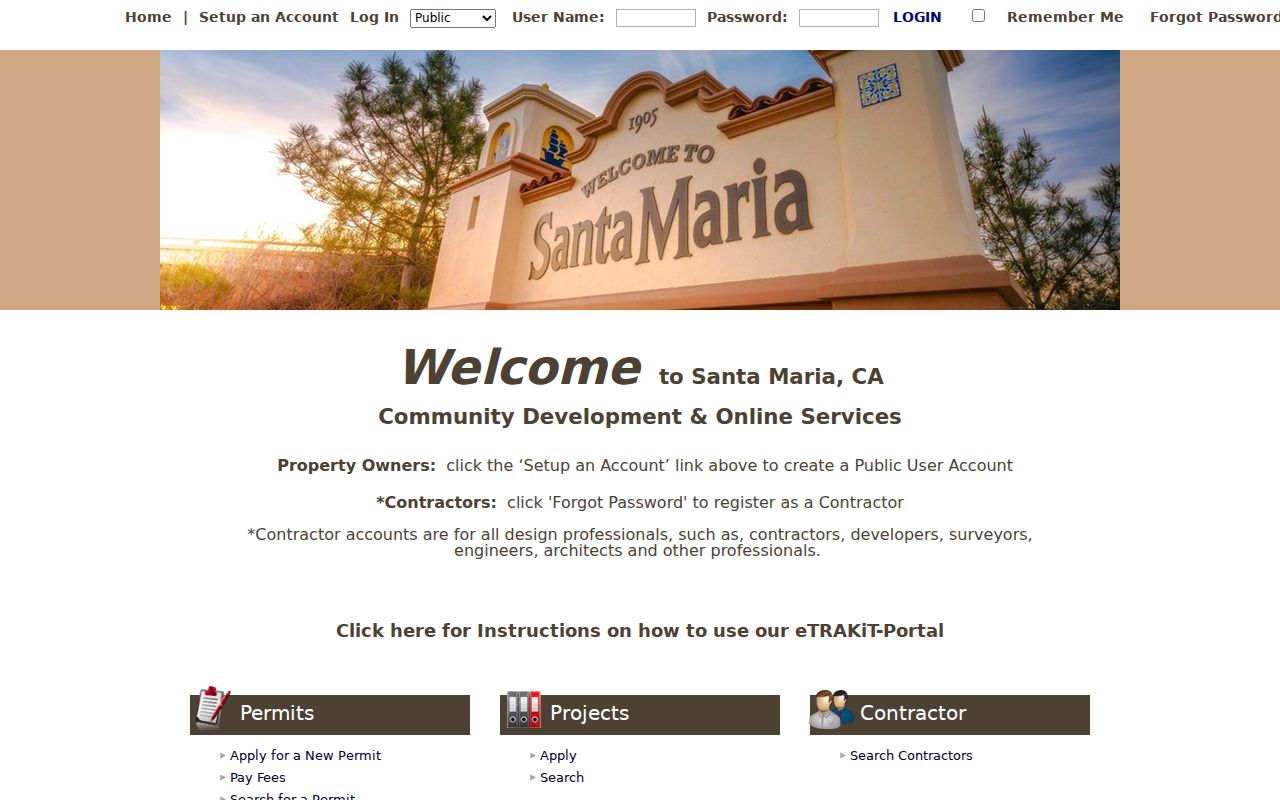
Inspection status is refreshed daily by 8 a.m., according to the guide. Jot down the permit number and date. If the public result runs dry, use the City Clerk or Community Development records route for more.
California Voter Status for Santa Maria
California's voter-status tool gets mistaken for a public Santa Maria resident lookup. It is not one. The form authenticates the requester through first name, last name, date of birth, and a driver license or state ID number, or the last four digits of a Social Security number. In return it shows the matching voter's status, party preference, voting location or district, and vote-by-mail or provisional information where applicable. A no-match proves nothing about where a person lives.
Election Code sections 2180 through 2194 restrict voter-registration information. Driver-license and Social Security values, unique identifiers, and signatures stay withheld. A full-file request goes only to permitted requesters and purposes, requires a declaration, and follows the state's application and fee schedule. That regime bears no resemblance to an open street directory. Safe at Home participants and other protected people can have addresses shielded too.
- First and last name: matches the registered form of the voter's name.
- Date of birth: provides an identity check rather than a public name filter.
- California ID or SSN4: one protected identifier is required as presented, with an “I do not have” option.
- Submit result: returns the authenticated voter's own status and election details.
The California voter-status lookup page illustrates that authenticated design. Use it to verify your own registration, not as a street-by-street list.
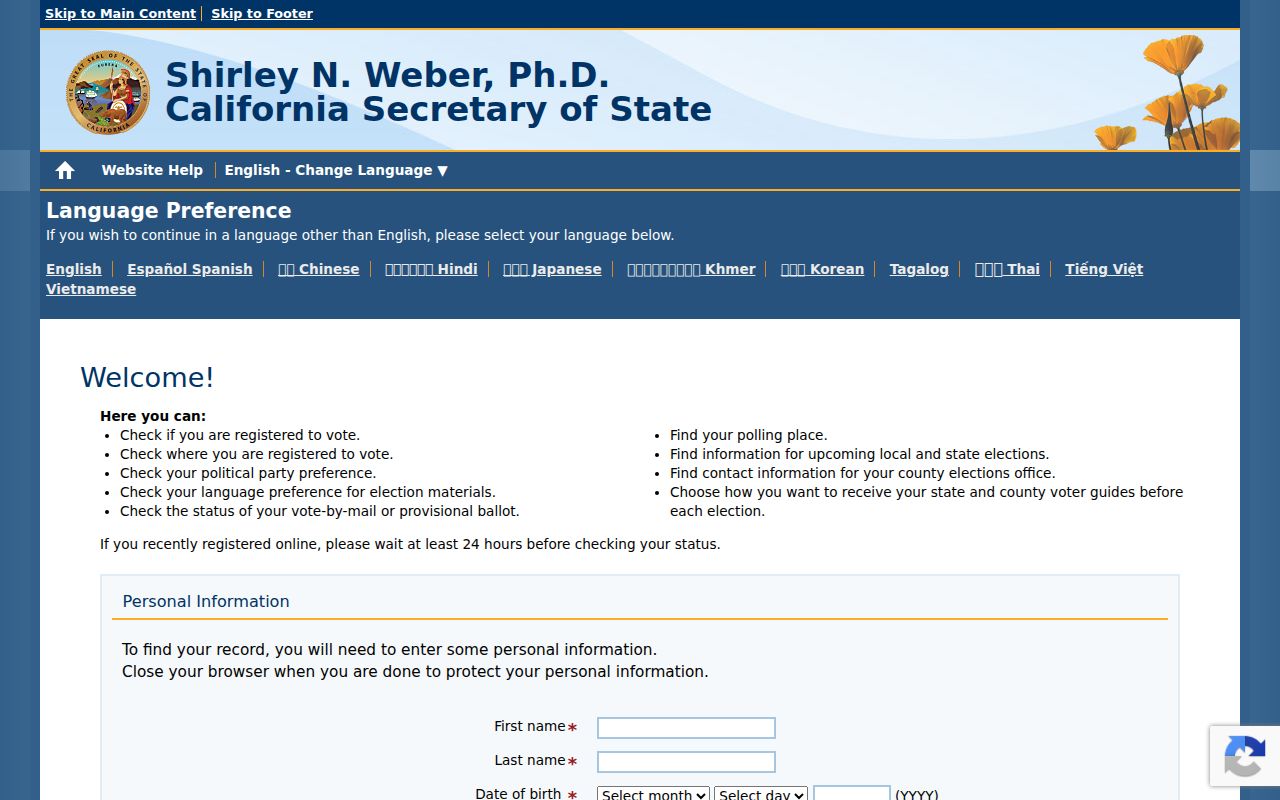
Note: Election results can show precinct or district totals, but they do not reveal how an individual cast a ballot.
Santa Maria Court Names and Dockets
Santa Maria cases belong to the Superior Court of California, County of Santa Barbara. Start with Smart Search when a case number, party name, or business name may exist. A public result can show a case number, caption, category, filing date, status, party roles, hearings, and register-of-actions entries. A disposition or judgment also appears when entered. Even so, a party match stays a lead. Case number, role, date, and geography must all line up first.
Remote access has practical limits. Case-number information is free. Party or business-name searches demand a login and search credits. Remotely available civil filing images cost $0.50 per page. Family, juvenile, adoption, sealed, confidential, mental-health, and restricted criminal material does not appear like an ordinary public civil docket. A Santa Maria clerk or public terminal often works better. A copy request can follow for ordinary, certified, or exemplified material.
The Santa Barbara Superior Court information hub explains locations, forms, records, and divisions. The court portal shows the first step before any clerk-file request.
Probate is especially useful for an heir trail. Petitions, notices, fiduciaries, and heirs may appear in a public file, while sensitive inventories or addresses stay restricted. Remember that court records establish a dated case relationship, not a current household.
Santa Maria CPRA Requests When Portals End
Santa Maria residents have a statutory fallback when records hide. The California Public Records Act now sits at Government Code sections 7920.000 and following. It reaches identifiable, nonexempt state and local records. The City Clerk page details inspection, direct reproduction costs, and a determination generally due within ten calendar days under Government Code section 7922.535, with a written unusual-circumstances extension of no more than fourteen days. A determination is not delivery. Day ten never guarantees every record in hand.
For non-police city records, the Santa Maria public-records request portal is the fastest route. The City Clerk's CPRA instructions are another starting point. A sharp request names the record series, a reasonable date range, and an address or APN, plus a permit or instrument number and the preferred inspection or electronic-copy method. Agencies must help identify records. They cannot conjure a resident list that never existed.
- Describe the existing record, such as permit history, council filing, contract, or nonexempt administrative record.
- Name Santa Maria, the department, the address or APN, and the time window that narrows the search.
- Ask for electronic inspection first and request an exemption or redaction explanation for withheld material.
- Track the request number and compare the response with the City's published fee and access terms.
The City request portal reflects one simple point. The records channel requests an existing city record, not a shortcut around a confidential series.
Note: Police, juvenile, medical, investigative, and personal identifying material can carry separate confidentiality rules even after a CPRA request.
Santa Maria's ZIP and Orcutt Postal Trap
Postal geography in Santa Maria can quietly misroute a records search. ZIP 93455 may read Santa Maria on the mailing line while the parcel actually sits in unincorporated Orcutt. Other addresses in 93454, 93456, and 93458 line up with Santa Maria planning geography. ZIP 93457 has its own south-area routing history. Remember what a ZIP does. It routes mail. It sets no city limit, tax parcel, or occupancy. For a mixed result, check the postal line with the USPS ZIP lookup, the boundary and parcel with County GIS, and the permit custodian with the jurisdiction. A blank eTRAKiT result can simply mean county regulation rather than a bad address. The 2017 USPS routing bulletin documents 93456 addresses moving from Guadalupe 93434 to Santa Maria 93454, though each address still needs current verification.
Santa Maria Vital Record Access
Birth, death, and public-marriage records sit with the County Clerk-Recorder for county events and with California Department of Public Health Vital Records for statewide copies. Divorce decrees come from Superior Court, not the recorder. California separates an authorized certified copy from an informational certified copy under Health and Safety Code sections 103525 and 103526. Confidential marriage copies are restricted to the parties or a court order.
The statewide system begins in July 1905 for births. The research record gives 2026 CDPH fees of $31 for birth, $26 for death, $19 for marriage, $18 for a dissolution certificate, $23 for fetal death, and $28 for stillbirth, with a no-record search retaining its fee. Verify the current record-specific form and fee before mailing. Historical indexes are not the same as eligibility for a modern certificate.
- Birth, death, or public marriage: use the County Recorder or CDPH route and distinguish a county event from the record type and copy category.
- Confidential marriage: use the County Recorder route and confirm party access or court-order authority.
- Divorce decree: use Santa Barbara Superior Court and distinguish the court judgment from a state statistical certificate.
The California Vital Records page carries record-specific applications and the ordering routes for each certificate type. A vital index may hint at a name or date, but the custodian always decides whether a certified copy can issue.
Santa Maria's Historical Directory Shelf
Start your historical Santa Maria residents directory search at the Santa Maria Public Library Special Collections. The second-floor Information Desk guards the city directories. It also holds telephone books, high-school yearbooks, government documents, and historic photographs. The collection adds more than 800 genealogy titles, plus regional newspaper microfilm reaching back to 1882. The library does not publish a complete publisher-by-year run online. Ask reference staff for the exact issue list, and do not assume a Polk span fills the gap.
An old city directory can list an adult with a spouse notation. Occupations, business affiliations, street addresses, and residence markers appear too. You may also find a telephone clue or owner and occupancy symbols. A reverse or criss-cross section flips the order to street and house number. That helps tie an old address to a name. It still only describes the listed person or subscriber, never the whole household. The Santa Maria city directory collections page covers the historical shelf and its reading methods in fuller detail.
Santa Maria's 1882 Newspaper Bridge
Regional newspaper microfilm beginning in 1882 predates Santa Maria's 1905 incorporation. That makes the library's newspaper shelf a bridge. It connects county-era records to the later city record system. Sales notices, street changes, and social announcements appear alongside business names, school events, and obituaries. Together they can explain why a residents directory entry vanishes. They can also explain why a deed party changes names.
Reference staff will retrieve up to three Santa Maria Times obituaries at no fee. Give a deceased person's name and death date. A two-week range is accepted. Add a return email or address. An obituary can link relatives and build a chronology. Treat it as secondary evidence, though. Pair it with a directory, deed, court, or vital record before drawing conclusions.
Santa Maria Matches Need Context
One place in Santa Maria can carry four different labels. A ZIP code moves the mail, while a situs marks the parcel the assessor values. A mailing address handles correspondence. A legal description pins the land itself to a lot, block, subdivision, or metes and bounds. Confusion creeps in when the systems disagree. A parcel may straddle an old annexation line. A road may have swapped names or numbers. A directory entry may still rely on a rural route from decades back. Keep the source date and the exact spelling with every match you accept.
- Roll
- A recurring list kept for a defined administrative purpose, such as assessment or election administration.
- Index
- A finding aid that points to a record; it is not always the image or certified copy.
- Parcel
- A mapped tax unit identified by an APN, which can change after splits or boundary work.
- Criss-cross directory
- A reverse directory arranged by street and number rather than only by surname.
Some addresses stay hidden on purpose. California's Safe at Home program shields qualifying participants. It gives them a substitute mailing address in place of their public one. DMV personal information is shielded too, under the federal Driver's Privacy Protection Act. A careful Santa Maria residents directory workflow respects those walls. When a lookup comes back empty, note the reason. Go back to the official custodian rather than trying to work around the protections.