
Sources for Santa Maria Previous Residents
The previous residents of a Santa Maria address appear in layers. Deeds track recorded title parties. City directories and telephone books track listed adults or subscribers. Census schedules show an enumerated household at one date. Newspaper microfilm, permits, Sanborn maps, obituaries, and probate files explain changes between those points.
| Source | Local coverage | Where held | What it shows |
|---|---|---|---|
| Modern Recorder index | After 1975 | Santa Barbara County Clerk-Recorder portal | Recorded transfers, liens, releases, and instrument parties |
| Historical Recorder index | 1931-1974 | County historical index and counter | Grantor-grantee bridge to older books |
| Older deed books and maps | Archive inventory controls exact years; records reach back to county formation routes | County Historical Archives and Surveyor finding aids | Early title, legal descriptions, and parcel configuration |
| City directories and telephone books | Exact run not published online | Santa Maria Public Library Special Collections | Listed adults, subscribers, addresses, and reverse street entries |
| Regional newspaper microfilm | Begins in 1882 | Santa Maria Public Library | Sales, moves, obituaries, notices, and street-change clues |
| Federal census | Open through 1950 under the 72-year rule | NARA and library Ancestry access | Household, relationship, age, birthplace, and occupation at enumeration |
| City building permits | eTRAKiT coverage not officially dated online | Santa Maria Community Development | Construction or alteration date and project parties |
Begin with a current APN for a title question, a directory or census for a household question, and newspapers or maps when the address itself has changed. No single source proves all previous residents.
Start Santa Maria House History
Begin the previous-resident trail with the current situs and APN. The County Assessor search accepts a house number, unit, street name, or parcel number, and recommends omitting street suffixes or trying a partial street name. The public result can show situs, transfer date, document number, use, jurisdiction, acreage, map, exemptions, and assessed value. It does not expose a public owner-name query.
Open the County GIS parcel next. Save the polygon, legal or subdivision reference, and jurisdiction before searching the Recorder. The APN is a present tax identifier, not a permanent historical key. A subdivision, merger, annexation, or parcel split can require following a predecessor parcel or a legal description instead.
The Santa Barbara County Assessor lookup is the address starting point. The County GIS access page supplies the spatial check.
Tracing Santa Maria Owners Through Deeds
The Santa Barbara County Recorder index lets a previous-resident search move from a current acquisition instrument backward. Search the relevant party name, date range, and document type. The advanced mode separates grantor and grantee, which matters because the seller in one transaction may be the earlier recipient in the chain.
- Confirm the current APN, situs, and legal description from the parcel record and map.
- Find the current acquisition instrument in the official records index and save its document number, date, parties, and book or page when shown.
- Search the seller or grantor as an earlier grantee. Repeat with trust names, organization names, married or maiden forms, and defensible spelling variants.
- Move across the County's post-1975 index and the 1931-1974 historical index without treating either as the whole record history.
- Use older books, maps, and the Historical Archives when the online layer ends. Follow predecessor parcels after a split rather than forcing today's APN backward.
- Grantor
- The party conveying an interest in a recorded instrument.
- Grantee
- The party receiving an interest in that instrument.
- Chain of title
- A linked sequence of recorded transfers showing how title moved between parties.
- Legal description
- The lot, block, subdivision, or metes-and-bounds description that can remain useful when a street number changes.
The County Recorder advanced search supports names, dates, grantor and grantee roles, document types, document numbers, and map book/page modes. Index entries are finding aids; images or copies establish the instrument details.
Crossing Santa Maria Recorder Cutoffs
The County describes a modern official-record search after 1975 and a separate historical index for 1931 through 1974. The current portal also describes indexed records beginning January 1, 1900. Keep those descriptions in the research note and test the instrument tier rather than choosing one cutoff as complete.
When an index ends, record its last book, page, date, or instrument clue and carry that bridge to the historical counter or archive. County Historical Archives says real-estate and vital records reach 1850 and recorded maps cover 1850 to the present. Surveyor finding aids identify map and survey series reaching into the nineteenth and early twentieth centuries.
The archive holdings page is represented below. Open the County Historical Archives record guide before assuming that an early deed or map is online.
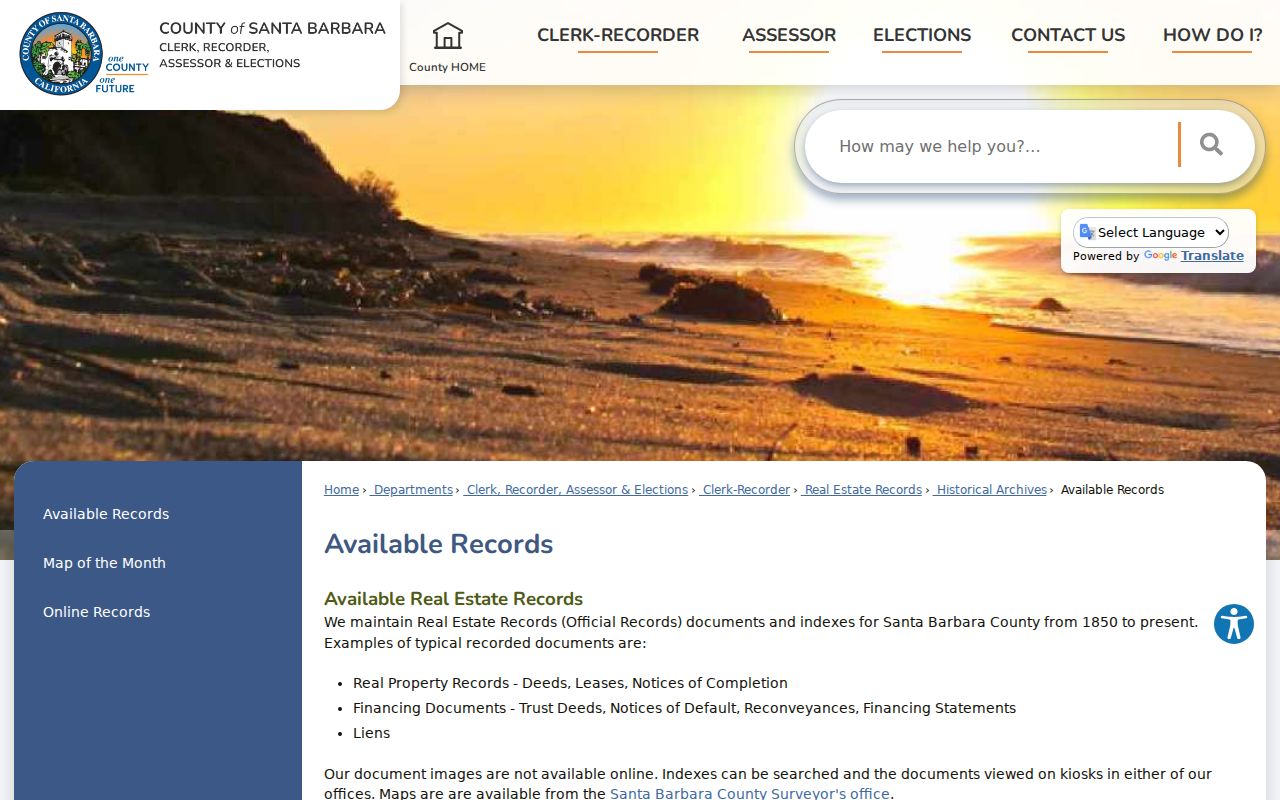
Archive access is the fallback when the portal stops, not evidence that the property history stops.
Following Predecessor Parcels in Santa Maria
Today's APN may not have existed when the previous residents lived at an address. Parcel splits, subdivision creation, annexation, rural-route conversion, renamed roads, and street renumbering can change the identifier. Compare the current legal description with recorded maps, assessor maps, Sanborn sheets, directory street guides, and newspaper notices.
A current owner-to-seller chain can therefore branch. Follow the predecessor parcel that matches the legal description or map, not only the number that appears on today's result. The County Surveyor map search includes recorded maps, APN overlays, corner records, intersection ties, Santa Maria tie-book sheets, parcel maps, and other series.
For a vanished number, search newspaper microfilm for the street name and terms such as renumber, annex, subdivision, or opened. Confirm any proposed continuity with a recorded map or a dated permit.
Repairing Santa Maria Address Breaks
Address continuity is a research problem of its own. Preserve directional forms, abbreviations, old street names, rural routes, and unit numbers. Santa Maria eTRAKiT expects one-letter directionals such as W rather than West. The Assessor form may ask for a street name without the suffix. A directory may use a historical form that neither modern portal accepts.
Test the old form in the library's reverse directory and newspaper microfilm, then compare the County Surveyor map or a Sanborn sheet. A gap between two previous residents can reflect a changed label rather than an empty period. Keep both forms in the notes and cite the source that links them.
Dating Santa Maria Buildings With Permits
Building permits and Sanborn maps can explain the physical setting around previous residents. Santa Maria eTRAKiT searches by address or parcel and can show permit numbers, status, inspections, applicant, contractor, and owner context. A permit party marks a project relationship, not proof of residence. The public guide says a city parcel or address must match, and the owner value may lag a recent transfer.
Sanborn sheets add earlier building footprints, materials, uses, street names, and numbers. The Library of Congress catalog verifies Santa Maria editions from 1886 through 1920, with editions in 1890, 1891, 1895, 1900, 1906, and 1909. Compare the sheet with a directory entry and recorded map before assuming a building is the same structure.
The run is not annual. The missing years can hide a remodel, a changed street number, or a parcel split, so a Sanborn gap should trigger a map or permit check rather than a conclusion about the house.
Use the Santa Maria eTRAKiT portal for the current permit route and the Library of Congress Sanborn collection for older map context. The two sources date different parts of a house history.
Closing a Santa Maria Trail With Probate
Probate and obituary records can close the previous-resident trail after a person leaves an address or dies. Superior Court probate petitions, notices, and orders may name a decedent, fiduciary, and heirs. Sensitive inventories or addresses can be restricted or redacted. A public case index is a lead; the clerk file supplies the allowed detail.
The Santa Maria Public Library's free obituary retrieval uses a deceased person's name and death date. Pair the result with a directory, deed, census, or vital record. A probate role can explain a transfer or family link, while a newspaper notice can explain a move or death. Neither source should be read as a complete list of everyone connected to the property.
For a probate search, capture the case number, filing date, party role, and court division first. Then request ordinary or certified copies through the Santa Barbara Superior Court route when the record is eligible. The Superior Court information hub lists divisions and records contacts.
Past Santa Maria Households in Print
Previous residents are not limited to deed holders. The Santa Maria Public Library's city directories, telephone books, regional newspaper microfilm, yearbooks, and on-site Ancestry access can show a listed adult, subscriber, household relationship, school link, or dated event. Begin with the newest directory issue available for the target era, then compare both alphabetical and reverse street sections.
Pair each directory year with the nearest open census schedule. A disappearance may mean a move, death, marriage or name change, military service, unlisted household, missing issue, or publication omission. The library's exact directory run is not published online, so verify the volume and publisher before treating the sequence as continuous. The historical collections themselves are covered on the Santa Maria city directory page.
The Santa Maria Valley Historical Society is another local-history lead. Check its public materials for a particular address or person, then use the County or Court custodian when a certified record is required.
Close a past-household trail with an obituary, probate case, deed, or newspaper notice when the source fits. Library reference staff retrieve up to three Santa Maria Times obituaries at no fee with a name and death date or two-week window. An obituary can identify relatives and chronology, but it should be matched with another record when the address matters.
House-history use. Previous-resident research is appropriate for personal history, genealogy, and property chronology. Do not use a historical name trail to track, threaten, harass, or harm a living person.